




$2.47 Each Prices subject to change



We never sell your data to third parties
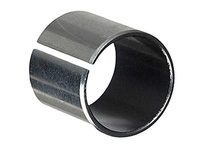
Isostatic 16TU16 steel-backed PTFE lined sleeve bearing, 1" I.D. x 1-1/8" O.D. x 1" length. Self-lubricating and maintenance-free for dry running applications. Suitable for pumps, motors, and conveyors.
MODEL 16TU16
This vendor has a minimum order quantity of 7. Order minimum ($) may be applied. Add desired QTY to cart and proceed to checkout to view minimum
Contact supplier for technical support on: 7732863444
$2.47 Each
Prices are subject to change
ADD $97.53 MORE FOR FREE SHIPPING
Select Quantity
Brand Minimum Order Quantity: 7
Typically Ships in: 1 day
Returnable: See conditions
I.D.
1 in
Length
1
Material
Steel-Backed PTFE Lined
Maximum Pressure
36250 psi
Maximum PV Rating
102000 psi/sq-ft/min
Maximum Velocity
1900 sfpm
O.D.
1 1/8 in
Temperature Rating
-328 to 536 deg F
Type
Round Bore
Isostatic TU Sleeve Bearings
- Standard stock products
- Self-lubricating dry sliding bearing
- A steel-backed composite material comprised of:
- Low carbon steel backing allows for extremely high load capacity - thickness. 50 – 2. 7 mm
- Sintered bronze offers optimal heat dispersion – thickness. 20 -. 35 mm
- PTFE – lead sliding surface creates a low friction coefficient and allows for a wide temperature range – thickness. 02 mm
- Can be used where many liquid lubricants fail; also performs well with lubrication
- Ideal for heavy loads at moderate speeds or light loads at high speeds – max Pv 102, 000, P-Load 36, 250, V-SFM-1, 900
- Effective in temperature range of -328°F to +536°F
- Standard tolerances vary by size. See items for specific tolerances
- REACH, DFARS compliant
Specifications
| Detailed Description | 1 IN I. D. x 1. 125 IN O. D. x 1. 0000 IN Length, TU, Steel Back, PTFE & Pb Lined Composite, Sleeve Bearing |
|---|---|
| Catalog Number | 16TU16 |
| Interchange # | 16DU16 PAPZ 1616 P10 |
| Unit of Measure | Each |
| Material | Steel-Backed PTFE Lined |
| Material Standard | Steel-Backed PTFE Lined |
| 0. 0568 lb | |
| UPC Code | 00846802053185 |
| Nominal Inner Diameter | 1 in |
| Nominal Outer Diameter | 1 1/8 in |
| Nominal Length | 1 in |
| Recommended Shaft Size | . 9979 to. 9991 in |
| Recommended Housing Bore | 1. 1247 to 1. 1255 in |
| Overall Length Tolerance | ±. 01 in |
| Load - P Max Value | 36, 250 lb/in² |
| Speed - V Max Value | 1, 900 ft²/min |
| Load at Speed - PV Max Value (P. S. I. / S. F. M. ) | 102, 000 |
No questions match your search.
What is PV rating and why does it matter? Bearing basics
PV rating (pressure × velocity) predicts bearing life under specific load and speed conditions. Exceeding the rated PV causes excessive heat and premature wear. Check your application's PV calculation against the bearing's rating before selection.
How are plain sleeve bearings different from ball bearings? Bearing basics
Plain bearings use sliding friction between surfaces, while ball bearings use rolling motion. Sleeve bearings cost less, tolerate misalignment, and work in high-speed or high-temperature applications. Ball bearings are more precise and require less maintenance.
How do I select the right plain sleeve bearing? Bearing basics
Measure the shaft diameter (bore), bearing length, and material, then verify your load and speed don't exceed the bearing's PV rating. Provide these specs to your supplier for the right part number. If you have an OEM part number, use it for exact replacements.
What applications use plain sleeve bearings? Bearing basics
Pumps, motors, turbines, compressors, gearboxes, and engine cranks commonly use sleeve bearings. They excel in high-load, high-speed machinery where simplicity and cost matter more than precision. Most industrial equipment has at least one sleeve bearing.
Do plain sleeve bearings require lubrication? Bearing basics
Standard bronze bearings require regular oil or grease lubrication. Self-lubricating bearings (graphite-filled or polymer) need little to no external maintenance but cost more. Check the datasheet to confirm your bearing's lubrication requirements.
How do I tell if a plain bearing is failing? Bearing basics
Listen for grinding or squealing noise and feel for excessive shaft play—both indicate loss of the lubrication film. Heat is another red flag; a hot-to-touch bearing has already lost critical clearance and needs immediate replacement.
When should I choose a plain bearing over a rolling-element bearing? Bearing basics
Plain bearings are ideal for high-temperature environments (above 200°C), dirty or contaminated conditions, and where simplicity and cost matter more than precision. They excel at slow speeds (below 100 RPM) with moderate radial loads and continuous lubrication.
What is the difference between sintered bronze and oil-lubricated plain bearings? Bearing basics
Sintered bronze (self-lubricating) bushings contain built-in lubricant and require no external oil—use them for sealed or hard-to-access locations. Oil-lubricated plain bearings (babbitt or solid bronze) need periodic or continuous oil supply and handle higher loads and speeds.
How do I size a plain bearing? Bearing basics
Measure your shaft diameter (bore), the housing space (OD), and the required axial width. Match the bore to your shaft, then select OD to fit your housing and width based on load requirements, referencing the manufacturer's load rating tables.
What load and speed limits do plain bearings have? Bearing basics
Sintered bronze handles 5–15 MPa at 1–2 m/s; oil-lubricated bronze handles 20–30 MPa at 3–5 m/s. Always check the material datasheet and stay within the PV limit (pressure × velocity) to prevent overheating.
What bearing materials are available and which should I use? Bearing basics
Standard bearing materials include: - Chrome Steel — Premium bearing steel used by SKF, NSK, Timken, and most manufacturers. Offers excellent hardness, fatigue resistance, and durability in standard industrial applications. Most common for ball and roller bearings. - Stainless Steel — Provides corrosion resistance for applications in wet, humid, or chemically corrosive environments. Used in food processing, marine, and pharmaceutical equipment. - Ceramic Hybrid Bearings — Combine steel races with ceramic rolling elements. Offer reduced friction, lower heat generation, and higher temperature capability. Used in high-speed, high-precision applications and aerospace. - Polymeric Bearings — Utilize fluoropolymer composites with embedded graphite or PTFE. Provide low friction in high-speed applications where lubrication film breakdown would be problematic. Material selection depends on operating environment (temperature, moisture, chemical exposure), speed, load, and precision requirements. Standard chrome steel bearings suit most industrial MRO applications.
What is a bearing and what does it do? Bearing basics
A bearing is a mechanical component that enables smooth rotational or linear motion by reducing friction between moving parts. Bearings support loads and facilitate the transfer of forces between moving elements, preventing direct metal-to-metal contact that would cause wear and heat buildup. Rolling element bearings contain balls or rollers that rotate within races (raceways) to minimize friction. Common types include ball bearings (used for moderate loads and high speeds), roller bearings (used for heavy loads at medium speeds), and angular contact bearings (designed for combined radial and axial loads). Bearings are essential in industrial equipment including motors, pumps, compressors, gearboxes, turbines, and conveyor systems.
How do I choose the right type of bearing for my application? Bearing basics
Start with the load and how it’s applied. You need to know if you’re dealing with radial loads, axial loads, or a mix of both. Then look at speed, operating environment, and space constraints. For example, ball bearings are great for high speed and lighter loads, while roller bearings handle heavier loads but usually at lower speeds. If there’s contamination, moisture, or heat involved, you may need sealed bearings or specific materials. In most cases, the right choice comes down to matching load type, speed, and environment to the bearing design.
How should I maintain and lubricate bearings? Bearing basics
Lubrication Importance — Improper lubrication causes over 40% of bearing failures. Proper bearing lubrication prevents friction damage, dissipates heat, protects against corrosion, and acts as a barrier against contaminants (dust, moisture, debris). Lubrication Selection — Choose between grease and oil based on: - Grease: Suitable for low-to-medium speed, sealed bearings, and applications without continuous circulation. Easier to apply and retain. Common for motors, household appliances, and sealed units. - Oil Mist or Circulating Systems: Better for high-speed applications, high-temperature environments, and heavy-load machinery where heat dissipation is critical. Best Practices: 1. Map all lubrication points and create a maintenance schedule. 2. Use the correct lubricant type and viscosity grade specified by the bearing manufacturer. 3. Store lubricants in sealed, labeled containers away from moisture and contaminants. 4. Monitor bearing temperature and vibration; unusual heat or noise may indicate inadequate lubrication or bearing wear. 5. Replace bearings before reaching L10 life if contamination or lubrication failure is detected.
What are dynamic and static load ratings, and why do they matter? Bearing basics
Static Load Rating (C₀) — The maximum load a stationary or slowly rotating bearing can support without permanent deformation of its rolling elements or raceways. Defined by ISO 76 as the load producing 0.01% permanent deformation of the rolling element diameter. Static load capacity is the limiting factor when a bearing operates at very low speeds or remains stationary under heavy loads. Dynamic Load Rating (C) — The constant load a bearing can endure for a specified number of revolutions (the L10 life, at which 90% of identical bearings are expected to survive). Dynamic load rating determines how long a bearing will last under rotating or oscillating motion. ISO 281 defines the L10 calculation using the formula: L10 = (C/P)^p, where C is dynamic load rating, P is equivalent dynamic load, and p is the life exponent (3 for ball bearings, 10/3 for roller bearings). Why They Matter — Static load rating determines if a bearing can handle peak loads without permanent damage (even if not rotating). Dynamic load rating determines operational life. For high-speed applications, dynamic rating is critical. For low-speed or stationary loads, static rating may be the limiting factor. Always verify both ratings against your application's load profile.
How do I choose the right bearing for my application? Bearing basics
Bearing selection depends on five key factors: 1. Load Type and Direction — Determine whether your application has radial loads (perpendicular to shaft), axial loads (along the shaft), or combined loads. Deep groove ball bearings suit primarily radial loads; tapered roller bearings excel at combined loads; thrust bearings handle pure axial forces. 2. Rotational Speed — Ball bearings support higher speeds with lower friction. Roller bearings are better for medium-speed, heavy-load applications. Verify bearing speed ratings against your operating RPM. 3. Load Capacity — Select a bearing with adequate load capacity for your application. Basic dynamic load rating (C) and basic static load rating (C₀) determine how much load the bearing can safely carry. 4. Lubrication Requirements — Choose between grease and oil lubrication based on speed, temperature, and load. High-speed or high-temperature applications typically require oil circulation; lower-speed applications can use grease. 5. Precision and Rigidity — Evaluate your application's tolerance for runout deviation. High-precision applications require tighter tolerances and higher-grade bearings.
What is bearing life (L10) and how does it affect my equipment maintenance? Bearing basics
L10 Life Definition (ISO 281) — L10 is the basic rating life at which 90% of a large group of identical bearings are statistically expected to survive under constant load and speed. It is calculated in millions of revolutions using the formula: L10 = (C/P)^p, where C is the basic dynamic load rating, P is the equivalent dynamic bearing load, and p is the life exponent (3 for ball bearings). Converting L10 to Operating Hours — To express L10 life in hours: L10h = (L10 × 10^6) / (60 × n), where n is rotational speed in RPM. For example, a bearing with L10 = 1,000 million revolutions operating at 3,600 RPM has approximately L10h ≈ 4,630 hours. Modified Life (L10a) — Actual bearing life also depends on lubrication quality, contamination, speed, temperature, and bearing accuracy. ISO 281 defines a modified life factor (a₁ × aISO) that adjusts the theoretical L10 for these real-world conditions. High-quality lubrication and proper maintenance can extend bearing life significantly; poor lubrication or high contamination reduces it. Why It Matters for Maintenance — L10 life helps you schedule preventive maintenance, budget for bearing replacement, and select bearings adequate for your duty cycle.
Bushings
Verified · SKU 1382448Fastest delivery yet 2 days. check out is simple. Have used before and will again . Read more
Owner/manager
Verified · SKU 1384817We have purchased your Isostatic bronze items for 3-4 years. We install them in machines we manufacture. We have never had any problems with them and our customers also like them. MRO Supply is very competitively priced and that is why we continue to order them from MRO Supply. Great rating for both Isostatic items & MRO Supply. Read more
Washer
Verified · SKU 1382258In time and perfect for my customer. Read more
D u bushing
Verified · SKU 1384606good price, fast shipping Read more

#6512948
Brand
RAB Lighting
Model
GDX17-330

#6099616
Brand
Superior Tool
Model
35012

#6302540
Brand
Starrett
Model
708AZ W/SLC

#2835674
Brand
Hammond Power Solutions
Model
C1F005GES

#581318
Brand
Dodge
Model
107360

#2310145
Brand
Alemite
Model
3530-A


#6301528
Brand
Starrett
Model
254Z-12