










We never sell your data to third parties
$83.89 Each
Prices are subject to change
FREE SHIPPING ON ORDERS OVER $100
Select Quantity
Returnable: Yes
B - Width
2.875 in 73.025 mm
C
9890 lbf 44000 N
C1 - Dynamic Radial Rating (1 million revolutions)
79600 lbf 354000 N
C90
20600 lbf 91800 N
C90 - Dynamic Radial Rating (90 million revolutions)
11900 lbf 52700 N
Cage Type
Stamped Steel
Cage-Cone Backface Clearance
0.12 in
Cage-Cone Frontface Clearance
0.1 in
Cone Backface 'To Clear' Radius
0.14 in
Cone Backface Backing Diameter
2.6 in
Cone Bore
1 3/4 in
Cone Frontface Backing Diameter
2.32 in
Cone Part Number
HM807040
Cone Width
1.4375 in
Cup Part Number
HM807010
d - Bore
1 3/4 in 44.450 mm
D - Cup Outer Diameter
4.1250 in 104.775 mm
Da - Cup Frontface Backing Diameter
3.96 in 100.10 mm
db - Cone Backface Backing Diameter
2.6 in 66 mm
Design Unit
Inch
Design Units
Imperial
Dynamic Radial Rating (1 million revolutions)
45700 lbf
Dynamic Radial Rating (90 million revolutions)
11900 lbf
Dynamic Radial Rating (Two-Row, 1 million revolutions)
79600 lbf
Dynamic Radial Rating (Two-Row, 90 million revolutions)
20600 lbf
e - ISO Factor
0.49
Effective Center Location
-0.29 in -7.4 mm
Factor
1.2
Geometry Factor
0.076
K - Factor
1.2
Outer Spacer Part Number
HM807010EE
R - Cone Backface "To Clear" Radius
0.02 in 0.50 mm
r - Cup Backface "To Clear" Radius
0.130 in 3.30 mm
Related Assembly Number(s)
HM807040-90028
Series
HM807000
Static Radial Rating
50200 lbf
T - Width
2.875 in 73.025 mm
Y1 - ISO Factor
1.38
Y2 - ISO Factor
2.06
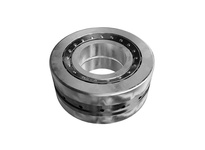
This is the most basic and most widely used type of tapered roller bearing. It consists of two main separable parts: the cone (inner ring) assembly and the cup (outer ring). It is typically mounted in opposing pairs on a shaft.
No questions match your search.
How do I choose the right type of bearing for my application? Bearing basics
Start with the load and how it’s applied. You need to know if you’re dealing with radial loads, axial loads, or a mix of both. Then look at speed, operating environment, and space constraints. For example, ball bearings are great for high speed and lighter loads, while roller bearings handle heavier loads but usually at lower speeds. If there’s contamination, moisture, or heat involved, you may need sealed bearings or specific materials. In most cases, the right choice comes down to matching load type, speed, and environment to the bearing design.
What is a bearing and what does it do? Bearing basics
A bearing is a mechanical component that enables smooth rotational or linear motion by reducing friction between moving parts. Bearings support loads and facilitate the transfer of forces between moving elements, preventing direct metal-to-metal contact that would cause wear and heat buildup. Rolling element bearings contain balls or rollers that rotate within races (raceways) to minimize friction. Common types include ball bearings (used for moderate loads and high speeds), roller bearings (used for heavy loads at medium speeds), and angular contact bearings (designed for combined radial and axial loads). Bearings are essential in industrial equipment including motors, pumps, compressors, gearboxes, turbines, and conveyor systems.
How do I choose the right bearing for my application? Bearing basics
Bearing selection depends on five key factors: 1. Load Type and Direction — Determine whether your application has radial loads (perpendicular to shaft), axial loads (along the shaft), or combined loads. Deep groove ball bearings suit primarily radial loads; tapered roller bearings excel at combined loads; thrust bearings handle pure axial forces. 2. Rotational Speed — Ball bearings support higher speeds with lower friction. Roller bearings are better for medium-speed, heavy-load applications. Verify bearing speed ratings against your operating RPM. 3. Load Capacity — Select a bearing with adequate load capacity for your application. Basic dynamic load rating (C) and basic static load rating (C₀) determine how much load the bearing can safely carry. 4. Lubrication Requirements — Choose between grease and oil lubrication based on speed, temperature, and load. High-speed or high-temperature applications typically require oil circulation; lower-speed applications can use grease. 5. Precision and Rigidity — Evaluate your application's tolerance for runout deviation. High-precision applications require tighter tolerances and higher-grade bearings.
What bearing materials are available and which should I use? Bearing basics
Standard bearing materials include: - Chrome Steel — Premium bearing steel used by SKF, NSK, Timken, and most manufacturers. Offers excellent hardness, fatigue resistance, and durability in standard industrial applications. Most common for ball and roller bearings. - Stainless Steel — Provides corrosion resistance for applications in wet, humid, or chemically corrosive environments. Used in food processing, marine, and pharmaceutical equipment. - Ceramic Hybrid Bearings — Combine steel races with ceramic rolling elements. Offer reduced friction, lower heat generation, and higher temperature capability. Used in high-speed, high-precision applications and aerospace. - Polymeric Bearings — Utilize fluoropolymer composites with embedded graphite or PTFE. Provide low friction in high-speed applications where lubrication film breakdown would be problematic. Material selection depends on operating environment (temperature, moisture, chemical exposure), speed, load, and precision requirements. Standard chrome steel bearings suit most industrial MRO applications.
What are dynamic and static load ratings, and why do they matter? Bearing basics
Static Load Rating (C₀) — The maximum load a stationary or slowly rotating bearing can support without permanent deformation of its rolling elements or raceways. Defined by ISO 76 as the load producing 0.01% permanent deformation of the rolling element diameter. Static load capacity is the limiting factor when a bearing operates at very low speeds or remains stationary under heavy loads. Dynamic Load Rating (C) — The constant load a bearing can endure for a specified number of revolutions (the L10 life, at which 90% of identical bearings are expected to survive). Dynamic load rating determines how long a bearing will last under rotating or oscillating motion. ISO 281 defines the L10 calculation using the formula: L10 = (C/P)^p, where C is dynamic load rating, P is equivalent dynamic load, and p is the life exponent (3 for ball bearings, 10/3 for roller bearings). Why They Matter — Static load rating determines if a bearing can handle peak loads without permanent damage (even if not rotating). Dynamic load rating determines operational life. For high-speed applications, dynamic rating is critical. For low-speed or stationary loads, static rating may be the limiting factor. Always verify both ratings against your application's load profile.
What is bearing life (L10) and how does it affect my equipment maintenance? Bearing basics
L10 Life Definition (ISO 281) — L10 is the basic rating life at which 90% of a large group of identical bearings are statistically expected to survive under constant load and speed. It is calculated in millions of revolutions using the formula: L10 = (C/P)^p, where C is the basic dynamic load rating, P is the equivalent dynamic bearing load, and p is the life exponent (3 for ball bearings). Converting L10 to Operating Hours — To express L10 life in hours: L10h = (L10 × 10^6) / (60 × n), where n is rotational speed in RPM. For example, a bearing with L10 = 1,000 million revolutions operating at 3,600 RPM has approximately L10h ≈ 4,630 hours. Modified Life (L10a) — Actual bearing life also depends on lubrication quality, contamination, speed, temperature, and bearing accuracy. ISO 281 defines a modified life factor (a₁ × aISO) that adjusts the theoretical L10 for these real-world conditions. High-quality lubrication and proper maintenance can extend bearing life significantly; poor lubrication or high contamination reduces it. Why It Matters for Maintenance — L10 life helps you schedule preventive maintenance, budget for bearing replacement, and select bearings adequate for your duty cycle.
How should I maintain and lubricate bearings? Bearing basics
Lubrication Importance — Improper lubrication causes over 40% of bearing failures. Proper bearing lubrication prevents friction damage, dissipates heat, protects against corrosion, and acts as a barrier against contaminants (dust, moisture, debris). Lubrication Selection — Choose between grease and oil based on: - Grease: Suitable for low-to-medium speed, sealed bearings, and applications without continuous circulation. Easier to apply and retain. Common for motors, household appliances, and sealed units. - Oil Mist or Circulating Systems: Better for high-speed applications, high-temperature environments, and heavy-load machinery where heat dissipation is critical. Best Practices: 1. Map all lubrication points and create a maintenance schedule. 2. Use the correct lubricant type and viscosity grade specified by the bearing manufacturer. 3. Store lubricants in sealed, labeled containers away from moisture and contaminants. 4. Monitor bearing temperature and vibration; unusual heat or noise may indicate inadequate lubrication or bearing wear. 5. Replace bearings before reaching L10 life if contamination or lubrication failure is detected.
Best company to buy from
Verified · SKU 5066946I always buy from MRO is a very reliable company to work with Read more

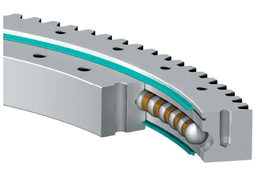
Slew ring bearings, also referred to as slewing bearings, slewing rings, or turntable bearings, are forms of bearings designed to allow rotational motion between several components.
Read More
#96662478
Brand
Dodge
Model
202260

#2845615
Brand
Cooper Wiring
Model
2053A

#6511917
Brand
RAB Lighting
Model
ALEDXLATN

#96702014
Brand
Thomson Linear
Model
511H15G1DG1

#6302746
Brand
Starrett
Model
PT99376

#6104731
Brand
JET Tools
Model
691175

#6268989
Brand
Drillco
Model
400N121

#6302732
Brand
Starrett
Model
PT99361