











We never sell your data to third parties
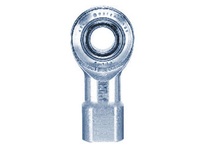
SealMaster TRE 8N 1400801000 precision male-threaded rod end with 0.5" bore and #1/2-20 UNF right-hand thread. Three-piece construction with carbon steel body, corrosion-resistant plating, and zerk fitting for lubrication. Used in actuator linkages and control rods.
MODEL 1400801000
Contact supplier for technical support on: 800-626-2120
$44.50 Each
Prices are subject to change
ADD $55.50 MORE FOR FREE SHIPPING
Select Quantity
Typically Ships in: 1 day
Returnable:No
Ability to Relubricate
Yes
Axial Load
700
Ball Diameter (in)
0.937
Ball Flat Diameter (in)
0.698
Ball Material
Alloy Steel - Heat Treated - Chrome Plated
Ball Width (in)
0.625
Bearing Type
Rod End
Class
Precision
Configuration
Male
Construction
Three-Piece Rod End with Zerk Fitting
Head Diameter (in)
1.312
Height
1
Housing Style
Male Rod End
Housing Width (in)
0.5
I.D.
0.5
Length
2.4
Length to Center of Ball (in)
2.44
Lubrication
Zerk Fitting
Lubrication Method
Fitting
Lubrication Type
Grease
Max Static Radial Load
7000
Maximum Ambient Temperature (F)
350
Misalignment Angle
6
Outer Material
Carbon Steel - Corrosion Resistant Plating
Product Type
TRE
Race Material
Carbon Steel - corrosion resistant plating
Series
Precision
Thread
RH
Thread Length (in)
1.469
Thread Size
#1/2-20
Thread Type
UNF
Type
Male Rod End
Width
3.35
Zerk Fitting SW
Y
| Configuration | Male |
|---|---|
| Bore | 0.5000 |
| Series | Precision |
| Construction | Three-Piece with Zerk Fitting |
| Lubrication Type | Grease |
| Max. Static Radial Load | 7, 000 |
| Misalignment Angle - a | 6.0 |
| Weight Unit of Measure: | EA |
|---|---|
| Weight: | 0.27 |
| Sale Qty Multiple: | 1 |
| Packaged Length: | 0 |
| Packaged Width: | 0 |
| Packaged Height: | 0 |
| No. Links/Ft. : | 0 |
| Configuration: | Male |
| Bore: | 0.5000 |
| Series: | Precision |
| Construction: | Three-Piece with Zerk Fitting |
| Lubrication Type: | Grease |
| Max. Static Radial Load: | 7, 000 |
| Misalignment Angle - a: | 6.0 |
| Outer Material: | Carbon Steel - corrosion resistant plating |
| Race Material: | Carbon Steel - corrosion resistant plating |
| Ball Material: | Alloy Steel - heat treated - chrome plated |
| Part No | Description | B | a | W | H | D |
|---|---|---|---|---|---|---|
| 1400801000 | TRE 8N | 0.5000 | 6.0 | 0.625 | 0.500 | 1.312 |
| F | A | M | Ball Dia. | O | ||
| 2.438 | 1.469 | 1/2-20 | 0.937 | 0.698 |



No questions match your search.
What load and torque specifications should I follow during installation? Bearing basics
Installation torque values vary by shank diameter and thread series and should be obtained from the manufacturer's technical datasheet for your specific rod end model; jam nut torque typically ranges from 25 to 80 N·m depending on shank size. Exceeding recommended torque can preload the bearing excessively and reduce service life.
How do I select the correct thread size and ensure compatibility? Bearing basics
Male threaded rod ends come in metric (M5–M42) or imperial (UNF/UNC) sizes, and thread compatibility is critical—a coarse UNC nut will not engage a fine UNF rod correctly. Verify that shank thread and mating nut/hole match exactly in series, pitch, and hand (right or left), as mismatched threads can damage both components and weaken the connection.
What are male threaded hollow bore rod ends typically used for? Bearing basics
Male threaded hollow bore rod ends are precision spherical plain bearings designed for hydraulic and pneumatic cylinder applications, machinery linkages, and mechanical transmissions. They provide articulated connections that allow for angular misalignment (typically up to 12°) while maintaining smooth rotational movement. The hollow bore design enables fluid passage, making them ideal for integrated hydraulic systems.
What material options are available and what are their load ratings? Bearing basics
Male threaded rod ends are available in chromium steel (SAE 52100) for general industrial applications with static radial load capacities ranging from approximately 15 kN to over 50 kN depending on bore size, and stainless steel (AISI 316/440C) for corrosive environments. For example, a typical 3/4-inch rod end offers static radial capacity of approximately 46,680 N (10,500 lbf). Always consult manufacturer datasheets for your specific bore size and series.
How should I maintain and lubricate male threaded rod ends? Bearing basics
Metal-to-metal rod ends require periodic lubrication with a thin grease layer at the ball OD; self-lubricating (Teflon-lined) rod ends are maintenance-free and should not be lubricated. Provide initial lubrication before commissioning and again after approximately 1 hour of running time, with routine inspection monitoring for play, binding, wear, corrosion, misalignment, and component damage.
Do hollow bore rod ends require regular lubrication? Bearing basics
PTFE/self-lubricating models are maintenance-free and suit hard-to-reach areas. Steel-on-bronze designs need relubrication every 500–1,000 hours and work best where loads are heavy and consistent.
What is the difference between hollow bore (unstudded) and studded rod ends? Bearing basics
Hollow bore rod ends have a plain threaded shank that bolts directly into a threaded hole, with no integral stud. Studded rod ends add a tapered stud on the pivot side for nut attachment. Choose hollow bore for lower-profile, direct-mount installations where a separate fastener controls the joint.
What load ratings should I check before specifying a rod end? Bearing basics
Verify both the dynamic (moving) and static (non-moving) load ratings against your worst-case application loads. Static ratings are typically 2–3× higher than dynamic for the same bore. Target a dynamic load rating of at least 1.5–2× your peak cyclic load to avoid premature failure.
How do I select the correct bore size for my application? Bearing basics
Match the bore diameter to your connecting pin or shaft OD exactly — common sizes run M5–M30 metric and #4–1/2" inch. Too large a bore creates play and wear; too small causes binding. Thread size (the shank) and bore size are independent specs, so confirm both before ordering.
What material and finish options are available for corrosion resistance? Bearing basics
Standard zinc-plated steel works for dry, indoor setups. Stainless steel with PTFE liners is the go-to for outdoor, marine, or chemical exposure—modest extra cost prevents corrosion-related failure.
Can I apply axial loads to rod ends? Bearing basics
Yes, but axial capacity is much lower than radial. Limit axial load to 15% of ultimate radial capacity (or 10% for three-piece designs) to avoid premature failure in the hoop tension area.
What's the difference between static and dynamic load ratings? Bearing basics
Static ratings apply to fixed loads or single-stroke applications. Dynamic ratings apply to continuous oscillating movement, like control linkages cycling repeatedly. For rod ends that move repeatedly, use the dynamic rating.
How often should rod ends be re-lubricated? Bearing basics
High-frequency rod ends (>100 cycles/hour) typically need re-greasing every 50–100 hours; slower applications can go 6–12 months. Use lithium-complex or polyurea greases per your bearing datasheet; PTFE-lined rod ends require no periodic lubrication.
What are common installation mistakes that shorten rod end life? Bearing basics
The top three are improper shim installation, neglecting to align the oil hole with the bearing passage, and over-torquing the mounting bolt. Always follow the OEM installation manual—assembly errors are the leading cause of early failure.
Why did my rod end ball discolor and stop moving? Bearing basics
Discoloration (blue, brown, or black marks) indicates overheating from inadequate lubrication, causing micro-welding between ball and race. Replace the rod end immediately and establish a re-greasing schedule to prevent recurrence.
What bearing materials are available and which should I use? Bearing basics
Standard bearing materials include: - Chrome Steel — Premium bearing steel used by SKF, NSK, Timken, and most manufacturers. Offers excellent hardness, fatigue resistance, and durability in standard industrial applications. Most common for ball and roller bearings. - Stainless Steel — Provides corrosion resistance for applications in wet, humid, or chemically corrosive environments. Used in food processing, marine, and pharmaceutical equipment. - Ceramic Hybrid Bearings — Combine steel races with ceramic rolling elements. Offer reduced friction, lower heat generation, and higher temperature capability. Used in high-speed, high-precision applications and aerospace. - Polymeric Bearings — Utilize fluoropolymer composites with embedded graphite or PTFE. Provide low friction in high-speed applications where lubrication film breakdown would be problematic. Material selection depends on operating environment (temperature, moisture, chemical exposure), speed, load, and precision requirements. Standard chrome steel bearings suit most industrial MRO applications.
What is a bearing and what does it do? Bearing basics
A bearing is a mechanical component that enables smooth rotational or linear motion by reducing friction between moving parts. Bearings support loads and facilitate the transfer of forces between moving elements, preventing direct metal-to-metal contact that would cause wear and heat buildup. Rolling element bearings contain balls or rollers that rotate within races (raceways) to minimize friction. Common types include ball bearings (used for moderate loads and high speeds), roller bearings (used for heavy loads at medium speeds), and angular contact bearings (designed for combined radial and axial loads). Bearings are essential in industrial equipment including motors, pumps, compressors, gearboxes, turbines, and conveyor systems.
How do I choose the right type of bearing for my application? Bearing basics
Start with the load and how it’s applied. You need to know if you’re dealing with radial loads, axial loads, or a mix of both. Then look at speed, operating environment, and space constraints. For example, ball bearings are great for high speed and lighter loads, while roller bearings handle heavier loads but usually at lower speeds. If there’s contamination, moisture, or heat involved, you may need sealed bearings or specific materials. In most cases, the right choice comes down to matching load type, speed, and environment to the bearing design.
How should I maintain and lubricate bearings? Bearing basics
Lubrication Importance — Improper lubrication causes over 40% of bearing failures. Proper bearing lubrication prevents friction damage, dissipates heat, protects against corrosion, and acts as a barrier against contaminants (dust, moisture, debris). Lubrication Selection — Choose between grease and oil based on: - Grease: Suitable for low-to-medium speed, sealed bearings, and applications without continuous circulation. Easier to apply and retain. Common for motors, household appliances, and sealed units. - Oil Mist or Circulating Systems: Better for high-speed applications, high-temperature environments, and heavy-load machinery where heat dissipation is critical. Best Practices: 1. Map all lubrication points and create a maintenance schedule. 2. Use the correct lubricant type and viscosity grade specified by the bearing manufacturer. 3. Store lubricants in sealed, labeled containers away from moisture and contaminants. 4. Monitor bearing temperature and vibration; unusual heat or noise may indicate inadequate lubrication or bearing wear. 5. Replace bearings before reaching L10 life if contamination or lubrication failure is detected.
What are dynamic and static load ratings, and why do they matter? Bearing basics
Static Load Rating (C₀) — The maximum load a stationary or slowly rotating bearing can support without permanent deformation of its rolling elements or raceways. Defined by ISO 76 as the load producing 0.01% permanent deformation of the rolling element diameter. Static load capacity is the limiting factor when a bearing operates at very low speeds or remains stationary under heavy loads. Dynamic Load Rating (C) — The constant load a bearing can endure for a specified number of revolutions (the L10 life, at which 90% of identical bearings are expected to survive). Dynamic load rating determines how long a bearing will last under rotating or oscillating motion. ISO 281 defines the L10 calculation using the formula: L10 = (C/P)^p, where C is dynamic load rating, P is equivalent dynamic load, and p is the life exponent (3 for ball bearings, 10/3 for roller bearings). Why They Matter — Static load rating determines if a bearing can handle peak loads without permanent damage (even if not rotating). Dynamic load rating determines operational life. For high-speed applications, dynamic rating is critical. For low-speed or stationary loads, static rating may be the limiting factor. Always verify both ratings against your application's load profile.
How do I choose the right bearing for my application? Bearing basics
Bearing selection depends on five key factors: 1. Load Type and Direction — Determine whether your application has radial loads (perpendicular to shaft), axial loads (along the shaft), or combined loads. Deep groove ball bearings suit primarily radial loads; tapered roller bearings excel at combined loads; thrust bearings handle pure axial forces. 2. Rotational Speed — Ball bearings support higher speeds with lower friction. Roller bearings are better for medium-speed, heavy-load applications. Verify bearing speed ratings against your operating RPM. 3. Load Capacity — Select a bearing with adequate load capacity for your application. Basic dynamic load rating (C) and basic static load rating (C₀) determine how much load the bearing can safely carry. 4. Lubrication Requirements — Choose between grease and oil lubrication based on speed, temperature, and load. High-speed or high-temperature applications typically require oil circulation; lower-speed applications can use grease. 5. Precision and Rigidity — Evaluate your application's tolerance for runout deviation. High-precision applications require tighter tolerances and higher-grade bearings.
What is bearing life (L10) and how does it affect my equipment maintenance? Bearing basics
L10 Life Definition (ISO 281) — L10 is the basic rating life at which 90% of a large group of identical bearings are statistically expected to survive under constant load and speed. It is calculated in millions of revolutions using the formula: L10 = (C/P)^p, where C is the basic dynamic load rating, P is the equivalent dynamic bearing load, and p is the life exponent (3 for ball bearings). Converting L10 to Operating Hours — To express L10 life in hours: L10h = (L10 × 10^6) / (60 × n), where n is rotational speed in RPM. For example, a bearing with L10 = 1,000 million revolutions operating at 3,600 RPM has approximately L10h ≈ 4,630 hours. Modified Life (L10a) — Actual bearing life also depends on lubrication quality, contamination, speed, temperature, and bearing accuracy. ISO 281 defines a modified life factor (a₁ × aISO) that adjusts the theoretical L10 for these real-world conditions. High-quality lubrication and proper maintenance can extend bearing life significantly; poor lubrication or high contamination reduces it. Why It Matters for Maintenance — L10 life helps you schedule preventive maintenance, budget for bearing replacement, and select bearings adequate for your duty cycle.

#2076446
Brand
Dodge
Model
142727

#522150
Brand
Rexnord
Model
10177518

#2837129
Brand
Hammond Power Solutions
Model
FS750ACP

#1380101
Brand
Isostatic
Model
PP-8000-1
Disclaimer: The return policy information below is merely a copy of the text as stated in Regal Beloit's Return Goods Policy.
File: http://documents.mrosupply.com/file_uploads/Emerson%20Return%20Goods%20Policy%20%28406-003%29.pdf
Past experience has shown us that it is both practical and necessary from the standpoint of good customer relations to accept occasional merchandise returns. It is the objective of this policy to set forth guidelines that will insure the prompt and efficient handling of these returns at the earliest possible date.
I. PROVISIONS GOVERNING ALL RETURNS OF POWER TRANSMISSION SOLUTIONS PRODUCTS
A. All returned goods must be authorized. A Returned Goods Authorization form or number must be obtained from the appropriate PTS Return Goods Department prior to shipment. PTS Business locations will not accept returns unless a Return Goods Authorization has been issued. In the event a shipment is received by any location without authorization, the material will be refused and the carrier instructed to return the shipment to the point of origin.
B. All requests for the return of PTS products should be directed to the attention of your Customer Service contact or the appropriate PTS Return Goods contact.
C. A Return Goods Authorization will be valid for thirty (30) days from date of issue. Please make your return shipment as soon as you have received the authorization.
D. All unused PTS products returned under this Return Goods Policy shall be in first class, salable condition in original packages and subject to PTS Business inspection. Used or damaged PTS products will not be accepted for credit, except as described under “Defective Merchandise”.
E. All returned PTS products must be shipped freight prepaid (unless otherwise instructed), and sent to the address shown on the Return Goods Authorization.
II. PTS ERRORS, CUSTOMER ERRORS, AND CONVENIENCE RETURNS
Order entry, shipping and packaging errors sometimes require that merchandise be returned, and/or credits be issued. It shall be our policy to accept the return of such merchandise when it can be shown that the product was billed on a specific invoice of recent date, subject to the following provisions:
A. “Recent Date” shall be defined as not more than sixty (60) days from shipping date.
B. Credit will be issued at the prices billed on our original invoice.
- Customer errors will be subject to a minimum 10% restocking charge.
C. For returns due to PTS error, we will credit freight both to and from the customer’s place of business.
D. For returns due to customer error, the customer will be responsible for both outbound and return freight charges.
- If the value of the material is less than $100, PTS will ask Distributors to hold for their annual return.
E. For convenience, returns where fault cannot be determined, PTS will credit the outbound freight and the customer is expected to pay the return freight.
III. DEFECTIVE MERCHANDISE (Reference PTS’s Standard Terms & Conditions of Sale)
Merchandise which has failed in use allegedly due to manufacturing defect or nonconformance to product specification may be returned with Return Authorization and invoice reference. We agree to repair or replace without charge any of our products which are found to be defective within one year after shipment, provided that the purchaser gives us immediate written notice of the alleged defect. (Note some products have extended warranty beyond one year. Please check with your appropriate PTS Return Goods Department for details.) We will not be liable for any damages or delay caused by such defects, nor shall we be responsible for work done or repairs made by others. Credit will be issued after inspection, as originally billed. Since all return freight is to be prepaid, if the product is defective and under warranty, PTS will issue credit for inbound and outbound freight.
IV. DISTRIBUTOR STOCK ADJUSTMENT RETURNS
The Distributor Stock Adjustment Policy is to ensure that our distributors’ inventory investment is in PTS products that provide satisfactory sales frequency and profitability. This policy also assists distributors in meeting their responsibility to maintain adequate levels of inventory in order to provide prompt service to their customers.
A distributor has the option of submitting a request for a Stock Adjustment Return of PTS products up to twice each calendar year. These two returns combined may total up to 3% of the distributors’ purchases of PTS product for the most recent PTS fiscal year ended September 30. For Stock Adjustment Returns greater than $50,000.00, the distributor may be required to submit an offsetting order, at the discretion of the appropriate PTS Sales V.P.
Additional provisions are:
A. All requests for return must include a detailed list of the PTS products to be returned. This list must include the complete product description and quantity.
B. Upon review and approval by the Return Goods Department, a return authorization will be issued. This authorization will be accompanied by a list of those items acceptable for return. Specials, made-to-order products, non-stock products, large OEM quantities, discontinued and/or obsolete products are unauthorized products and will have been excluded from the list. Only authorized product may be returned.
C. Once the distributor has received the return authorization, the approved products should be immediately shipped to the designated PTS facility. This return authorization will be valid for thirty (30) days from the date of issue.
D. All Distributor Stock Adjustment credits will be based on current distributor published or applicable program prices, less:
a. Standard 10% restocking and handling charge
b. Unauthorized freight charges
c. 20% for repackaging
d. 50% for refurbishing and reconditioning
E. If any unauthorized products are returned, they will not be included in the credit. A written notice will be sent to the distributor requesting advice as to disposition of the product. If the distributor does not advise disposition within fifteen (15) days, the unauthorized product will be scrapped. If the distributor requests a return, it will be done freight collect.
F. Some PTS products have limited shelf life and are subject to special return limitations. Please contact your Sales Representative or Return Goods Department for details.