











We never sell your data to third parties
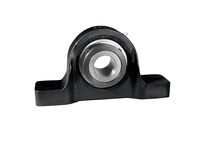
Link-Belt (Rexnord) PU323N 10426217 1 43662 PILLOW BLOCK BALL BEARING
MODEL 10426217
Contact supplier for technical support on: 800-626-2120
$377.91 Each
Prices are subject to change
FREE SHIPPING ON ORDERS OVER $100
Select Quantity
Returnable:No

#17335
Brand
AMI Bearings
Model
UCFT206-20

#23360
Brand
Baldor
Model
EM2539T

#24106
Brand
Baldor
Model
EM2513T

#24963
Brand
Baldor
Model
M3602
Available end cap
U3236C
Available seal type
N double lip seal;H labyrinth seal
Base Length (in)
9.25
Base to centerline height (in)
2 3/8 in
Base Width (in)
2.38
Bearing housing
Pillow block 2 bolt 300 series
Bearing Type
Heavy duty ball brg
Bolt hole spacing (width) (in)
7.38
Bore
1 7/16 in
Bore length (in)
2 3/32 in
Bore Shape
Straight
C dynamic load rating
7490 lb
Cage Material
Molded fiber glass reinforced nylon
Cage Type
Ball Riding Retainer
Co static load rating
4290 lb
Distance between bolt holes (in)
7 3/8 in
Distance from Bearing Centerline to Cap Face (in)
1 1/2 in
Distance from Bearing Centerline to Outer Most Bearing Face (in)
1 1/4 in
Expansion
No
Foot Height (in)
1
Grease fitting size
1/8 NPT
Height
5.50
Housing Base
Semi-Solid
Housing coating
Powder coated
Housing Color
Black
Housing construction
One Piece
Housing height (in)
4 1/2 in
Housing material
Cast iron
Inner Ring Outside Diameter (in)
1.946
Insert
UG323L
Insert Material
Bearing steel
Length
9.50
Locking
Single set collar
Locking collar outside diameter (in)
2 9/16 in
Locking device kit
U3235S
Lubricant
Lithium Complex NLGI 2 Grease
Lubrication type
EXXON RONEX MP STD
Max Speed
5400 rpm
Max temperature (°F (°C))
225 (107) F (C)
Maximum Temperature (C)
107
Misalignment Capability
±2.0° Misalignment - Static Only
Misalignment Type
Static Only
Mounted clearance
C3 standard
Mounting bolt hole slot length (in)
1 1/8 in
Mounting bolt size (in)
5/8 in
Mounting pad height (in)
1 in
Mounting pad length (in)
9 1/4 in
Mounting pad width (in)
2 3/8 in
Outer Ring Land Profile
Standard
Relubrication
Yes
Retainer type
Nylon
Rolling element
Ball Bearing
Seal
BUNA DBL LIP SEAL WITH FLGRS
Service instructions
BR3-007 LB 200 ball-300 ball
Setscrew torque (in-lbs)
165-185 in/lbs
Size code
323
Total expansion capability
3/16 in
Unit of dimension
in
Vibration frequency fundamental train
0.0063 cps
Vibration frequency inner ring defect
0.0823 cps
Vibration frequency outer ring defect
0.0510 cps
Vibration frequency roller spin
0.0335 cps
Volume
0.707
Volume unit
GLL
Width
3.13
Bearings The Link-Belt (Rexnord) PU323N 10426217 1 43662 Pillow Block Ball Bearing is engineered to provide superior performance and reliability in various heavy-duty applications. Designed specifically for demanding environments, this 2-bolt pillow block bearing features a robust construction that ensures longevity and minimal maintenance requirements.
Key Features
| High Load Capacity | Capable of supporting heavy radial and axial loads, enhancing the bearing's operational efficiency in industrial settings. |
|---|---|
| Durable Construction | Manufactured with high-quality materials to withstand harsh conditions and extend service life. |
| Precision Engineering | Features an optimal internal design that minimizes friction, resulting in smoother operation and reduced energy consumption. |
| Sealed Design | Equipped with integrated seals to prevent contamination from dust and moisture, ensuring reliable performance in outdoor applications. |
| Easy Installation | The 2-bolt mounting design allows for quick and straightforward installation on various machinery and equipment. |
Applications
| Construction Equipment | Ideal for use in cranes, excavators, and other heavy machinery requiring robust bearing solutions. |
|---|---|
| Agricultural Machinery | Suitable for applications in farming equipment, providing reliability under fluctuating loads. |
| Manufacturing Systems | Perfect for conveyor systems and industrial machinery where durability and performance are crucial. |
| Transportation and Logistics | Designed to meet the demands of mobile equipment, enhancing operational efficiency in transportation applications. |
Benefits
| Enhanced Durability | The high-quality construction offers resistance to wear and tear, significantly reducing the need for frequent replacements. |
|---|---|
| Increased Efficiency | The precision design reduces friction, leading to improved performance and energy savings in machinery operations. |
| Reliability | With a focus on quality and engineering excellence, Link-Belt products like the PU323N ensure dependable operation even in the most challenging environments. |
No questions match your search.
How do I read a Link-Belt 200 series ball bearing part number like P3U247N or FX3S224E? This product
Link-Belt 200 series numbers run housing, a 3 for integral bearing seals, locking, series, bore and seal. In P3U247N, P is a pillow block, U a wide inner ring with spring locking setscrews, 2 the 200 series, 47 the shaft size in sixteenths of an inch (2-15/16 in) and N a single lip seal. FX3S224E is a 2-bolt flange (FX) with a narrow inner ring spring locking insert (S), a 1-1/2 in bore and a molded lip seal (E). Other housings: F (3 and 4-bolt flange), FC (piloted cartridge), PL (low backing), PT (tapped base). A leading M (MFS251N) marks medium duty. Klean-Gard washdown units (KLPSS216) use their own code: KL polypropylene housing, SS stainless insert.
What is the difference between Link-Belt 200 series and 300 series ball bearings such as PU347? This product
The 300 series is Link-Belt's heavy duty line. It uses larger balls and thicker rings, a wide case carburized inner ring that resists fracture under shock, and an anti-rotation pin that stops the outer ring spinning in the housing. The 200 series covers the standard, intermediate and medium duty units. A 300 number reads housing, locking, 3, bore: PU347 is a standard backing pillow block with spring locking (U) for a 2-15/16 in shaft, with the standard steel clad clearance seal; N adds a double lip seal. E after the housing letter is an expansion unit, K an adapter mount (PEU3K55), A the SHURLOK tapered adapter, P2 a high backing pillow block and PL low backing.
Which shaft locking should I pick on a Link-Belt ball bearing: U, S, Y, W, CL or K? This product
The letter after the housing code gives the locking. U (wide inner ring) and S (narrow inner ring) are spring locking: correctly torqued setscrews strain the collar so it keeps pressure on the threads. Y (wide) and W (narrow) use an eccentric cam collar, turned in the direction of shaft rotation and then set. CL is Centrik-Lok, a two-piece collar with eight tabs that centers the shaft and keeps the setscrews off it, which eases removal. On 300 series units, K is a tapered adapter (U3K00) that allows commercial grade shafting and A is the SHURLOK adapter (PA347). Setscrew torques by size are in the BR3-007 installation sheet; do not grease the bore or shaft on U3K00 units.
What do the H, N, E, E3, N3, FF and E1 seal codes mean on a Link-Belt ball bearing? This product
On 200 series units, H is a floating labyrinth seal and N a single lip seal, with a flinger through the 212 size and on all CL units, and without one from the 213 size up. E is a molded single lip seal, E3 a triple lip seal and N3 a narrow triple lip seal. FF means flingers only, for free running or over 400F duty with light dirt; HFF and MHFF are flingers with a 10 percent oil or grease fill. E1 is a 400F high temperature package: extra internal clearance, riveted steel retainer, high temperature grease and Viton seals. S200 and W200 units come with the E seal; other standard duty units, medium duty M units (MPS, MFS) and CL units use N as standard. On 300 series units no seal letter means the steel clad clearance seal and N the double lip seal.
Can I replace just the insert in a Link-Belt mounted ball bearing, and how is it numbered? This product
Yes. Replacement inserts drop the housing code and add G for relubricatable: UG, SG, YG and WG in the 200 series and UG, YG or AG in the 300 series. Cataloged SG inserts carry an LPA suffix, so SG216ELPA is a 1 in spring locking insert with a molded lip seal, and UG351L is a 3-3/16 in 300 series insert with the clearance seal. A trailing L includes collar and setscrews, L1 omits the collar, and B marks a cylindrical outer ring. To change it, remove the collar or adapter, swing the insert 90 degrees and lift it out through the loading slots. Line its lube holes up with the housing grease groove, and do not reuse a worn housing. Always follow Rexnord's service instructions for the unit.
What sizes are available for 2-bolt pillow block bearings? Bearing basics
2-bolt pillow block bearings are available with shaft bore diameters ranging from 1/2" to 4", with standard duty models typically handling RPM ratings between 2,500 and 3,000. Common sizes include 1-3/4", 2", 2-3/16", and 3-1/8" bores for most general industrial applications.
What's the proper installation procedure for 2-bolt pillow blocks? Bearing basics
Slide the bearing onto the shaft and use a rubber mallet with a hardwood block to gently tap it into position—never strike the housing or seals directly. Once aligned, secure both mounting bolts firmly to the mounting surface while ensuring the shaft remains parallel and properly aligned.
How often should I re-lubricate 2-bolt pillow blocks? Bearing basics
Most 2-bolt pillow blocks ship pre-packed with NLGI #2 lithium complex grease and require re-lubrication roughly every 2 months when operating at 1,000 RPM and 150°F. At lower speeds or cooler conditions, re-lubrication intervals can be extended; always use a grease compatible with the original lubricant family to avoid compatibility issues.
What load capacity should I expect from a 2-bolt pillow block? Bearing basics
Load capacity varies significantly by bore size and duty rating; standard duty models typically carry lower radial loads compared to medium or heavy-duty variants of the same size. Consult the manufacturer's datasheet for your specific bore size to confirm the dynamic and static load ratings for your application.
How can I tell if my 2-bolt pillow block needs replacement? Bearing basics
Watch for excessive heat, unusual grinding or squealing noise, or visible vibration during operation, which often indicate misalignment or insufficient lubrication. Verify shaft alignment with a laser tool and check grease condition before replacing the unit, as these are common causes of premature failure.
How much misalignment can a pillow block bearing tolerate? Bearing basics
Most pillow block bearings with spherical roller designs allow up to ±2–3° of angular misalignment to accommodate minor shaft deflection and installation tolerances. This angular freedom makes them ideal for machinery where perfect alignment is difficult to achieve, such as conveyor systems and pump shafts.
What are typical bore sizes available for pillow block bearings? Bearing basics
Pillow block bearings are commonly available in metric bore sizes ranging from 12mm to 75mm, with popular series like UCP200 complying to ISO 113 boundary dimensions. Common smaller sizes (UCP201–UCP204) handle 12–20mm shafts, while larger sizes (UCP210–UCP215) accommodate 50–75mm shafts for heavy industrial applications.
Are pillow block bearings pre-lubricated, and how often should they be re-lubricated? Bearing basics
Pillow block bearings are supplied pre-greased and sealed, requiring no lubrication at startup. Under standard operating conditions, occasional re-lubrication with light machine oil (every 6–12 months) or per manufacturer guidelines is sufficient; sealed designs minimize maintenance compared to open-style housings.
What materials are used in pillow block bearing housings? Bearing basics
Pillow block housings are typically constructed from ductile iron or steel stampings, with internal bronze or steel liners and neoprene or elastomer flex layers that absorb vibration and dampen shaft movement. The housing design provides both structural rigidity and vibration isolation for long bearing life in industrial equipment.
What is the difference between a pillow block bearing and a loose bearing? Bearing basics
A pillow block bearing is a complete mounted assembly with the bearing pre-installed in a housing frame ready for shaft mounting, while a loose bearing is the bearing component alone. Pillow blocks provide simplified installation, self-alignment up to ±2°, and bolt-down convenience for machinery support applications.
How often should I grease a mounted bearing? Bearing basics
Use the formula (OD in mm) × (Width in mm) × 0.005 = grams for periodic relubrication of the bearing element only; initial housing cavity fill is separate and should be 30–50% of free volume. Over-greasing damages seals and generates excess heat—stick to the calculated quantity and recommended relubrication schedule.
How do I install a mounted bearing correctly? Bearing basics
Verify your shaft diameter is within the bearing bore tolerance (consult the NSK or SKF datasheet), then secure the bearing to the mounting surface using the specified bolt torque and engage the locking collar or set-screw on the shaft to prevent axial slip. Hand-rotate the shaft through several complete turns with a dial indicator, laser alignment tool, or feeler gauge to confirm smooth operation and proper shaft runout within spec.
What are the main types of mounted bearings? Bearing basics
Mounted bearings come in four main forms: pillow blocks (flat-base, shaft parallel to mounting surface), flange mounts (perpendicular shaft, available in 2-bolt and 4-bolt variants with different radial ratings), hanger bearings (overhead support for long horizontal shafts), and take-up frames (adjustable center-distance units for belt or chain drive tensioning). Select based on your shaft orientation, load direction, and space constraints.
When should I replace a mounted bearing? Bearing basics
Replace based on condition: vibration signature analysis or ultrasonic emission (detected with a hand-held meter) indicates wear hours or days before audible noise appears, and is the actionable MRO signal. Other replacement triggers include continuous operation above 80°C housing temperature, visible grease leakage, or reaching the manufacturer's service interval for your duty cycle. Scheduled relubrication and temperature monitoring extend service life significantly — replacement is a last resort, not preventive maintenance.
What temperature should a mounted bearing run at? Bearing basics
Monitor housing surface temperature (the standard MRO measurement point): 40–65°C is normal, 70–75°C warrants investigation of misalignment or over-greasing, and 80°C requires immediate shutdown. The inner race runs 15–30°C hotter than the housing surface, so an 80°C housing reading means lubricant degradation is accelerating and the bearing requires emergency diagnosis.
What are dynamic and static load ratings, and why do they matter? Bearing basics
Static Load Rating (C₀) — The maximum load a stationary or slowly rotating bearing can support without permanent deformation of its rolling elements or raceways. Defined by ISO 76 as the load producing 0.01% permanent deformation of the rolling element diameter. Static load capacity is the limiting factor when a bearing operates at very low speeds or remains stationary under heavy loads. Dynamic Load Rating (C) — The constant load a bearing can endure for a specified number of revolutions (the L10 life, at which 90% of identical bearings are expected to survive). Dynamic load rating determines how long a bearing will last under rotating or oscillating motion. ISO 281 defines the L10 calculation using the formula: L10 = (C/P)^p, where C is dynamic load rating, P is equivalent dynamic load, and p is the life exponent (3 for ball bearings, 10/3 for roller bearings). Why They Matter — Static load rating determines if a bearing can handle peak loads without permanent damage (even if not rotating). Dynamic load rating determines operational life. For high-speed applications, dynamic rating is critical. For low-speed or stationary loads, static rating may be the limiting factor. Always verify both ratings against your application's load profile.
How do I choose the right bearing for my application? Bearing basics
Bearing selection depends on five key factors: 1. Load Type and Direction — Determine whether your application has radial loads (perpendicular to shaft), axial loads (along the shaft), or combined loads. Deep groove ball bearings suit primarily radial loads; tapered roller bearings excel at combined loads; thrust bearings handle pure axial forces. 2. Rotational Speed — Ball bearings support higher speeds with lower friction. Roller bearings are better for medium-speed, heavy-load applications. Verify bearing speed ratings against your operating RPM. 3. Load Capacity — Select a bearing with adequate load capacity for your application. Basic dynamic load rating (C) and basic static load rating (C₀) determine how much load the bearing can safely carry. 4. Lubrication Requirements — Choose between grease and oil lubrication based on speed, temperature, and load. High-speed or high-temperature applications typically require oil circulation; lower-speed applications can use grease. 5. Precision and Rigidity — Evaluate your application's tolerance for runout deviation. High-precision applications require tighter tolerances and higher-grade bearings.
What bearing materials are available and which should I use? Bearing basics
Standard bearing materials include: - Chrome Steel — Premium bearing steel used by SKF, NSK, Timken, and most manufacturers. Offers excellent hardness, fatigue resistance, and durability in standard industrial applications. Most common for ball and roller bearings. - Stainless Steel — Provides corrosion resistance for applications in wet, humid, or chemically corrosive environments. Used in food processing, marine, and pharmaceutical equipment. - Ceramic Hybrid Bearings — Combine steel races with ceramic rolling elements. Offer reduced friction, lower heat generation, and higher temperature capability. Used in high-speed, high-precision applications and aerospace. - Polymeric Bearings — Utilize fluoropolymer composites with embedded graphite or PTFE. Provide low friction in high-speed applications where lubrication film breakdown would be problematic. Material selection depends on operating environment (temperature, moisture, chemical exposure), speed, load, and precision requirements. Standard chrome steel bearings suit most industrial MRO applications.
What is a bearing and what does it do? Bearing basics
A bearing is a mechanical component that enables smooth rotational or linear motion by reducing friction between moving parts. Bearings support loads and facilitate the transfer of forces between moving elements, preventing direct metal-to-metal contact that would cause wear and heat buildup. Rolling element bearings contain balls or rollers that rotate within races (raceways) to minimize friction. Common types include ball bearings (used for moderate loads and high speeds), roller bearings (used for heavy loads at medium speeds), and angular contact bearings (designed for combined radial and axial loads). Bearings are essential in industrial equipment including motors, pumps, compressors, gearboxes, turbines, and conveyor systems.
How do I choose the right type of bearing for my application? Bearing basics
Start with the load and how it’s applied. You need to know if you’re dealing with radial loads, axial loads, or a mix of both. Then look at speed, operating environment, and space constraints. For example, ball bearings are great for high speed and lighter loads, while roller bearings handle heavier loads but usually at lower speeds. If there’s contamination, moisture, or heat involved, you may need sealed bearings or specific materials. In most cases, the right choice comes down to matching load type, speed, and environment to the bearing design.
How should I maintain and lubricate bearings? Bearing basics
Lubrication Importance — Improper lubrication causes over 40% of bearing failures. Proper bearing lubrication prevents friction damage, dissipates heat, protects against corrosion, and acts as a barrier against contaminants (dust, moisture, debris). Lubrication Selection — Choose between grease and oil based on: - Grease: Suitable for low-to-medium speed, sealed bearings, and applications without continuous circulation. Easier to apply and retain. Common for motors, household appliances, and sealed units. - Oil Mist or Circulating Systems: Better for high-speed applications, high-temperature environments, and heavy-load machinery where heat dissipation is critical. Best Practices: 1. Map all lubrication points and create a maintenance schedule. 2. Use the correct lubricant type and viscosity grade specified by the bearing manufacturer. 3. Store lubricants in sealed, labeled containers away from moisture and contaminants. 4. Monitor bearing temperature and vibration; unusual heat or noise may indicate inadequate lubrication or bearing wear. 5. Replace bearings before reaching L10 life if contamination or lubrication failure is detected.
What is bearing life (L10) and how does it affect my equipment maintenance? Bearing basics
L10 Life Definition (ISO 281) — L10 is the basic rating life at which 90% of a large group of identical bearings are statistically expected to survive under constant load and speed. It is calculated in millions of revolutions using the formula: L10 = (C/P)^p, where C is the basic dynamic load rating, P is the equivalent dynamic bearing load, and p is the life exponent (3 for ball bearings). Converting L10 to Operating Hours — To express L10 life in hours: L10h = (L10 × 10^6) / (60 × n), where n is rotational speed in RPM. For example, a bearing with L10 = 1,000 million revolutions operating at 3,600 RPM has approximately L10h ≈ 4,630 hours. Modified Life (L10a) — Actual bearing life also depends on lubrication quality, contamination, speed, temperature, and bearing accuracy. ISO 281 defines a modified life factor (a₁ × aISO) that adjusts the theoretical L10 for these real-world conditions. High-quality lubrication and proper maintenance can extend bearing life significantly; poor lubrication or high contamination reduces it. Why It Matters for Maintenance — L10 life helps you schedule preventive maintenance, budget for bearing replacement, and select bearings adequate for your duty cycle.

#12441
Brand
AMI Bearings
Model
KHF211-32

#2038269
Brand
United Abrasives
Model
72051

#2785345
Brand
Zero-Max
Model
215

#2271780
Brand
Browning
Model
767328

#6416923
Brand
MROSupply Fasteners
Model
FSTPCK-313600

#264746
Brand
Martin Sprocket
Model
78CS9 2 15/16

#470661
Brand
Thomas
Model
310962

#6061084
Brand
Pramet
Model
6755272