







We never sell your data to third parties
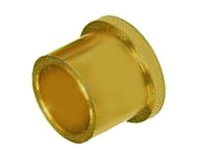
Isostatic SF-4048-8 Oilube SAE841 powdered metal bronze flanged bearing, 1-1/4" I.D. x 1-1/2" O.D. x 1/2" length. Oil-impregnated and self-lubricating for maintenance-free operation. Max PV 50,000, temperature range +10°F to +220°F. Ideal for light-duty applications in pumps, conveyors, and machine tools.
MODEL SF-4048-8
This vendor has a minimum order quantity of 7. Order minimum ($) may be applied. Add desired QTY to cart and proceed to checkout to view minimum
Contact supplier for technical support on: 7732863444
$2.59 Each
Prices are subject to change
FREE SHIPPING ON ORDERS OVER $100
Select Quantity
Brand Minimum Order Quantity: 7
Typically Ships in: 1 day
Returnable: See conditions
Bore Diameter
1-1/4 in
Flange Diameter
1-11/16 in
Flange Width
1/8 in
I.D.
1 1/4 in
Length
1/2
Material
Powdered Metal / Oil Impregnated Bronze
Maximum Pressure
2000 psi
Maximum PV Rating
50000 psi/sq-ft/min
Maximum Velocity
1200 sfpm
O.D.
1 1/2 in
Temperature Rating
10 to 175 deg F
Type
Round Bore
Isostatic Oilube Bearings / Bushings
- Standard stock products
- SAE 841-copper (87-90%), tin (8-9), carbon, other elements
- Powdered metal bronze providing interconnected reservoirs for oil
- Vacuum impregnated with SAE 30 oil during the manufacturing process (approx. 19% by vol. )
- Self-lubricating – when in motion oil rises to the surface for lubrication and restores itself when at rest
- Ideal for heavy loads at moderate speeds or light loads at high speeds – max Pv 50, 000, P-Load 2, 000, V-SFM-1, 200
- Effective in temperature range of +10°F to + 175°F with standard oil
- Available in oils for other temperature ranges on a made-to-order basis
- Standard tolerances vary by size. See items for specific tolerances
- RoHS, REACH, DFARS compliant
Specifications
| Detailed Description | 1. 252 IN I. D. x 1. 503 IN O. D. x 1/2 IN Length x 1-11/16 IN Flange O. D. x 1/8 IN Flange Thick, SAE 841 Powdered Metal Bronze, Flange Bearing |
|---|---|
| Catalog Number | SF-4048-8 |
| Interchange # | SF4048-8 |
| Unit of Measure | Each |
| Material | Powdered Metal / Oil Impregnated Bronze |
| Material Standard | SAE 841 |
| Avg Unit Weight | 0. 0761 lb |
| UPC Code | 00846802049904 |
| Nominal Inner Diameter | 1 1/4 in |
| Nominal Outer Diameter | 1 1/2 in |
| Nominal Length | 1/2 in |
| Flange Nominal Outer Diameter | 1 11/16 in |
| Flange Nominal Thickness | 1/8 in |
| Inner Diameter Tolerance | +. 000, -. 001 in |
| Outside Diameter Tolerance | +. 000, -. 0015 in |
| Overall Length Tolerance | ±. 005 in |
| Flange Diameter Tolerance | ±. 01 in |
| Flange Thickness Tolerance | ±. 01 in |
| Load - P Max Value | 2, 000 lb/in² |
| Speed - V Max Value | 1, 200 ft²/min |
| Load at Speed - PV Max Value (P. S. I. / S. F. M. ) | 50, 000 |
SKU: 1384022
Sleeve bearings ep141620
Fair price and fast free shipping! Most other sites charge more for the shipping than the cost of the items. Will use this company for future bearing purchases.
Read moreSKU: 1380654
Answer your review request
Have purchased the Isostatic sintered bronze items instead of Symmco and they work just as well, but cost less $.
Read moreWhat's the proper installation procedure?
Clean the mounting surface and bearing thoroughly. Inspect for damage before installation. Press the flanged bearing onto the shaft using an arbor press—never hammer it on, as this damages the race. Align the mounting holes with the housing chamfer (aim for 25–30 degrees), then bolt the flange to the housing. Verify that the shaft is centered and rotates freely. Loose mounting causes misalignment-induced wear and noise.
Should I choose a self-lubricating or grease-packed bearing?
Self-lubricating (polymer-based) bearings transfer microscopic lubricant amounts from the material itself—zero external lubrication needed, lower maintenance, sealed against contamination. Grease-packed (bronze or babbitt) bearings require periodic greasing or oil circulation but handle higher loads and run cooler in heavy-duty applications. Choose self-lubricating for light-load, sealed environments; choose grease-packed for high-load industrial duty.
How often should I lubricate and maintain my flanged bearings?
Self-lubricating bearings require no maintenance after installation. Grease-packed bearings should be re-greased every 500–1,000 operating hours (or per OEM guidance), depending on speed and load. Inspect quarterly for wear, noise, or visible leakage. Keep the bearing housing clean—dirt accelerates wear. If you see resistance during shaft rotation or hear grinding, stop and replace the bearing immediately.
How do I select the right size and load rating?
Start with these three specs: bore diameter (matches your shaft), outer diameter and flange dimensions (for housing fit), and load rating. Most plain flanged bearings are rated by pressure-velocity (PV) value—multiply the bearing pressure (load ÷ projected area) by surface velocity (RPM). Don't exceed the material's PV limit (typically 25,000–40,000 psi for bronze) or you risk lubrication breakdown and overheating. Verify shaft alignment tolerance to ±0.002"—misalignment accelerates wear.
What's the difference between a plain flanged bearing and a standard sleeve bearing?
A flanged bearing has an integrated collar (flange) around the outer diameter that acts as a mounting shoulder, eliminating the need for a separate spacer or retaining ring. This flange simplifies installation, reduces assembly time, and ensures repeatable alignment. Use flanged bearings when space is tight and you need quick, reliable mounting without adjustable positioning.
How do I tell if a plain bearing is failing?
Listen for grinding or squealing noise and feel for excessive shaft play—both indicate loss of the lubrication film. Heat is another red flag; a hot-to-touch bearing has already lost critical clearance and needs immediate replacement.
When should I choose a plain bearing over a rolling-element bearing?
Plain bearings are ideal for high-temperature environments (above 200°C), dirty or contaminated conditions, and where simplicity and cost matter more than precision. They excel at slow speeds (below 100 RPM) with moderate radial loads and continuous lubrication.
What is the difference between sintered bronze and oil-lubricated plain bearings?
Sintered bronze (self-lubricating) bushings contain built-in lubricant and require no external oil—use them for sealed or hard-to-access locations. Oil-lubricated plain bearings (babbitt or solid bronze) need periodic or continuous oil supply and handle higher loads and speeds.
How do I size a plain bearing?
Measure your shaft diameter (bore), the housing space (OD), and the required axial width. Match the bore to your shaft, then select OD to fit your housing and width based on load requirements, referencing the manufacturer's load rating tables.
What load and speed limits do plain bearings have?
Sintered bronze handles 5–15 MPa at 1–2 m/s; oil-lubricated bronze handles 20–30 MPa at 3–5 m/s. Always check the material datasheet and stay within the PV limit (pressure × velocity) to prevent overheating.
What bearing materials are available and which should I use?
Standard bearing materials include: - Chrome Steel — Premium bearing steel used by SKF, NSK, Timken, and most manufacturers. Offers excellent hardness, fatigue resistance, and durability in standard industrial applications. Most common for ball and roller bearings. - Stainless Steel — Provides corrosion resistance for applications in wet, humid, or chemically corrosive environments. Used in food processing, marine, and pharmaceutical equipment. - Ceramic Hybrid Bearings — Combine steel races with ceramic rolling elements. Offer reduced friction, lower heat generation, and higher temperature capability. Used in high-speed, high-precision applications and aerospace. - Polymeric Bearings — Utilize fluoropolymer composites with embedded graphite or PTFE. Provide low friction in high-speed applications where lubrication film breakdown would be problematic. Material selection depends on operating environment (temperature, moisture, chemical exposure), speed, load, and precision requirements. Standard chrome steel bearings suit most industrial MRO applications.
What is a bearing and what does it do?
A bearing is a mechanical component that enables smooth rotational or linear motion by reducing friction between moving parts. Bearings support loads and facilitate the transfer of forces between moving elements, preventing direct metal-to-metal contact that would cause wear and heat buildup. Rolling element bearings contain balls or rollers that rotate within races (raceways) to minimize friction. Common types include ball bearings (used for moderate loads and high speeds), roller bearings (used for heavy loads at medium speeds), and angular contact bearings (designed for combined radial and axial loads). Bearings are essential in industrial equipment including motors, pumps, compressors, gearboxes, turbines, and conveyor systems.
How do I choose the right type of bearing for my application?
Start with the load and how it’s applied. You need to know if you’re dealing with radial loads, axial loads, or a mix of both. Then look at speed, operating environment, and space constraints. For example, ball bearings are great for high speed and lighter loads, while roller bearings handle heavier loads but usually at lower speeds. If there’s contamination, moisture, or heat involved, you may need sealed bearings or specific materials. In most cases, the right choice comes down to matching load type, speed, and environment to the bearing design.
How should I maintain and lubricate bearings?
Lubrication Importance — Improper lubrication causes over 40% of bearing failures. Proper bearing lubrication prevents friction damage, dissipates heat, protects against corrosion, and acts as a barrier against contaminants (dust, moisture, debris). Lubrication Selection — Choose between grease and oil based on: - Grease: Suitable for low-to-medium speed, sealed bearings, and applications without continuous circulation. Easier to apply and retain. Common for motors, household appliances, and sealed units. - Oil Mist or Circulating Systems: Better for high-speed applications, high-temperature environments, and heavy-load machinery where heat dissipation is critical. Best Practices: 1. Map all lubrication points and create a maintenance schedule. 2. Use the correct lubricant type and viscosity grade specified by the bearing manufacturer. 3. Store lubricants in sealed, labeled containers away from moisture and contaminants. 4. Monitor bearing temperature and vibration; unusual heat or noise may indicate inadequate lubrication or bearing wear. 5. Replace bearings before reaching L10 life if contamination or lubrication failure is detected.
What are dynamic and static load ratings, and why do they matter?
Static Load Rating (C₀) — The maximum load a stationary or slowly rotating bearing can support without permanent deformation of its rolling elements or raceways. Defined by ISO 76 as the load producing 0.01% permanent deformation of the rolling element diameter. Static load capacity is the limiting factor when a bearing operates at very low speeds or remains stationary under heavy loads. Dynamic Load Rating (C) — The constant load a bearing can endure for a specified number of revolutions (the L10 life, at which 90% of identical bearings are expected to survive). Dynamic load rating determines how long a bearing will last under rotating or oscillating motion. ISO 281 defines the L10 calculation using the formula: L10 = (C/P)^p, where C is dynamic load rating, P is equivalent dynamic load, and p is the life exponent (3 for ball bearings, 10/3 for roller bearings). Why They Matter — Static load rating determines if a bearing can handle peak loads without permanent damage (even if not rotating). Dynamic load rating determines operational life. For high-speed applications, dynamic rating is critical. For low-speed or stationary loads, static rating may be the limiting factor. Always verify both ratings against your application's load profile.
How do I choose the right bearing for my application?
Bearing selection depends on five key factors: 1. Load Type and Direction — Determine whether your application has radial loads (perpendicular to shaft), axial loads (along the shaft), or combined loads. Deep groove ball bearings suit primarily radial loads; tapered roller bearings excel at combined loads; thrust bearings handle pure axial forces. 2. Rotational Speed — Ball bearings support higher speeds with lower friction. Roller bearings are better for medium-speed, heavy-load applications. Verify bearing speed ratings against your operating RPM. 3. Load Capacity — Select a bearing with adequate load capacity for your application. Basic dynamic load rating (C) and basic static load rating (C₀) determine how much load the bearing can safely carry. 4. Lubrication Requirements — Choose between grease and oil lubrication based on speed, temperature, and load. High-speed or high-temperature applications typically require oil circulation; lower-speed applications can use grease. 5. Precision and Rigidity — Evaluate your application's tolerance for runout deviation. High-precision applications require tighter tolerances and higher-grade bearings.
What is bearing life (L10) and how does it affect my equipment maintenance?
L10 Life Definition (ISO 281) — L10 is the basic rating life at which 90% of a large group of identical bearings are statistically expected to survive under constant load and speed. It is calculated in millions of revolutions using the formula: L10 = (C/P)^p, where C is the basic dynamic load rating, P is the equivalent dynamic bearing load, and p is the life exponent (3 for ball bearings). Converting L10 to Operating Hours — To express L10 life in hours: L10h = (L10 × 10^6) / (60 × n), where n is rotational speed in RPM. For example, a bearing with L10 = 1,000 million revolutions operating at 3,600 RPM has approximately L10h ≈ 4,630 hours. Modified Life (L10a) — Actual bearing life also depends on lubrication quality, contamination, speed, temperature, and bearing accuracy. ISO 281 defines a modified life factor (a₁ × aISO) that adjusts the theoretical L10 for these real-world conditions. High-quality lubrication and proper maintenance can extend bearing life significantly; poor lubrication or high contamination reduces it. Why It Matters for Maintenance — L10 life helps you schedule preventive maintenance, budget for bearing replacement, and select bearings adequate for your duty cycle.
SKU: 1384022
Sleeve bearings ep141620
Fair price and fast free shipping! Most other sites charge more for the shipping than the cost of the items. Will use this company for future bearing purchases.
Read moreSKU: 1380654
Answer your review request
Have purchased the Isostatic sintered bronze items instead of Symmco and they work just as well, but cost less $.
Read more