









We never sell your data to third parties
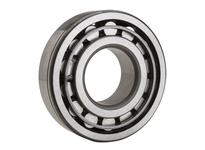
NTN MU1209DAV is a heavy-industrial cylindrical roller bearing with a 45 mm straight bore. It features an open enclosure and a one piece steel cage. The MU series design includes an inner ring with two ribs and a separable outer ring with one rib, accommodating axial expansion. This bearing is constructed from hardened alloy steel for durability in demanding industrial applications.
MODEL MU1209DAV
$127.87 Each
Prices are subject to change
FREE SHIPPING ON ORDERS OVER $100
Select Quantity
Typically Ships in: 1 day
Returnable:No
B (in)
1.7717
Bore Type
Round
Bore type
Round
C (in)
2.9520
Cage Material
One Piece Steel
Cage material
One piece steel
Configuration
One
D (in)
3.3480
Dynamic Load Rating
14400 lbf
Dynamic load rating
14400 lbf
Enclosure
Open
F (in)
2.3240
H (in)
2.8272
Material
Hardened alloy steel
Oil Hole
w/o Oil Hole
Oil hole
w/o Oil Hole
Operating Temperature Range
-40 to 250 °F
Operating temperature range
-40 to 250 ºF
R (in)
0.0598
r (in)
0.0402
Radial Internal Clearance
CN
Radial internal clearance
CN
Static Load Rating
16900 lbf
Static load rating
16900 lbf
Tolerance
ISO class 0 (RBEC 1)
Type
Cylindrical Roller Bearing
U (Plain Rings)
2.0787 in
V (Rib Rings)
2.1811 in
W
0.7480 in
Width
0.748
X (Plain Rings)
3.0787 in
Z (Rib Rings)
2.9488 in
Technical Specifications
Type | Cylindrical Roller Bearing |
Bore Type | Round |
Material | Hardened Alloy Steel |
Cage Material | One Piece Steel |
Configuration | One |
Tolerance | ISO Class 0 (RBEC 1) |
Oil Hole | w/o Oil Hole |
Radial Internal Clearance | CN |
Static Load Rating | 16900 lbf75000 N75.00 kN |
Dynamic Load Rating | 14400 lbf64000 N64.00 kN |
Enclosure | Open |
Weight | 1.074 lb0.487 kg |
Operating Temperature Range | -40 to 250 F-40 to 120 C |
Dimensional Specifications
| |
B | 1.7717 in45.000 mm |
D | 3.3480 in85.039 mm |
W | 0.7480 in19.000 mm |
C | 2.9520 in74.980 mm |
F | 2.3240 in59.030 mm |
H | 2.8272 in71.810 mm |
R | 0.0598 in1.520 mm |
U (Plain Rings) | 2.0787 in52.800 mm |
V (Rib Rings) | 2.1811 in55.400 mm |
X (Plain Rings) | 3.0787 in78.200 mm |
Z (Rib Rings) | 2.9488 in74.900 mm |
r | 0.0402 in1.020 mm |


How do I choose the right type of bearing for my application?
Start with the load and how it’s applied. You need to know if you’re dealing with radial loads, axial loads, or a mix of both. Then look at speed, operating environment, and space constraints. For example, ball bearings are great for high speed and lighter loads, while roller bearings handle heavier loads but usually at lower speeds. If there’s contamination, moisture, or heat involved, you may need sealed bearings or specific materials. In most cases, the right choice comes down to matching load type, speed, and environment to the bearing design.
