









We never sell your data to third parties
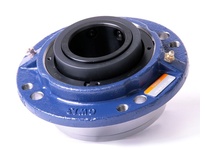
Timken QAC15A300SB piloted flange spherical roller mounted unit with 300mm shaft diameter. This housed unit combines a spherical roller bearing insert with a piloted flange housing for heavy-duty applications requiring high radial load capacity and self-alignment. Suitable for industrial gearboxes, conveyors, and process equipment.
MODEL QAC15A300SB
$594.16 Each
Prices are subject to change
FREE SHIPPING ON ORDERS OVER $100
Select Quantity
Typically Ships in: 1 day
Returnable:No
0.050 mm Shaft Size
3 in Shaft Tolerance:0.0020 in
0.051 mm Shaft size type
Imperial Y1 - Geometry Factor:3.14 Y2 - Geometry Factor:4.67 e - Geometry Factor:0.22
0.080 mm Pre Install Clearance Min
0.0020 in
100.3 mm Dimension L Fix
3.86 in
109 mm Dimension B Exp
2.7 in
16 mm Dimension KA
1.25 in
190.5 mm Dimension J (Bolt Size)
0.625 in
31.8 mm Dimension L Exp
3.95 in
6.1 mm Dimension SA
3.62 in
66.3 mm Dimension BC
7.5 in
68.6 mm Dimension B Fix
2.61 in
91.9 mm Eng Internal Radial Clearance - Max
0.0031 Eng Internal Radial Clearance - Min:0.0020 Engineering group:Mounted Bearing Float:0.083 in
98 mm Dimension RA
0.24 in
Bearing number
22215 C - Dynamic Load (Basic):49900 lbf 222000 N C0 - Static Load:54100 lbf 240000 N Dimension:4.29 in
Bearing Number
22215
C - Dynamic Load (Basic)
49900 lbf 222000 N
C0 - Static Load
54100 lbf 240000 N
Dimension B Exp
2.7 in 68.6 mm
Dimension B Fix
2.61 in 66.3 mm
Dimension BC
7.5 in 190.5 mm
Dimension C
4.29 in 109 mm
Dimension D
6.38 in 162.1 mm
Dimension E
5.3 in 134.6 mm
Dimension F
8.75 in 222.3 mm
Dimension G
6.375 in 161.9 mm
Dimension H
0.81 in 20.6 mm
Dimension J (Bolt Size)
0.625 in 16 mm
Dimension KA
1.25 in 31.8 mm
Dimension L Exp
3.95 in 100.3 mm
Dimension L Fix
3.86 in 98 mm
Dimension M
2.37 in 60.2 mm
Dimension N
1.25 in 31.8 mm
Dimension RA
0.24 in 6.1 mm
Dimension SA
3.62 in 91.9 mm
Dynamic Load (Basic)
49900 lbf
e - Geometry Factor
0.22
Eng Internal Radial Clearance - Max
0.0031
Eng Internal Radial Clearance - Min
0.0020
Eng Internal Radial ClearancMax
0.0031
Eng Internal Radial ClearancMin
0.002
Engineering Group
Mounted Bearing
Float
0.083 in 2.108 mm
Full Timken Part Number
QAC15A300SB QAC15A300SBNG QAC15A300SC QAC15A300SEB QAC15A300SEBNG QAC15A300SEC QAC15A300SEM QAC15A300SEN QAC15A300SEO QAC15A300SET QAC15A300SM QAC15A300SN QAC15A300SO QAC15A300ST
Geometry Factor
4.67
Grease Lubrication - B/C/O Seal
1300 rpm
Grease Lubrication - M/N Seal
1600 rpm
Grease Lubrication - T Seal
2400 rpm
Housing Construction
Piloted Flange Cartridge
Locking Style
Single Concentric
Oil Lubrication - B/C/O Seal
1300 rpm
Oil Lubrication - M/N Seal
1600 rpm
Oil Lubrication - T Seal
2900 rpm
Pre Install Clearance Max
0.0031 in 0.080 mm
Pre Install Clearance Min
0.0020 in 0.050 mm
Shaft Size
3 in
Shaft Size Type
Imperial
Shaft Tolerance
0.0020 in 0.051 mm
Static Load
54100 lbf
Y1 - Geometry Factor
3.14
Y2 - Geometry Factor
4.67
Bearings The Timken QAC15A300SB SRB Housed Unit is a high-performance engineered bearing solution designed for robust applications in the automotive and industrial sectors. This piloted flange bearing unit is expertly crafted to provide superior reliability and efficiency, ensuring optimal performance in demanding environments.
Key Features
| Type | Self-Aligning Roller Bearing (SRB) |
|---|---|
| Size | 15-inch shaft diameter with a 300mm overall length |
| Material | High-quality steel construction for enhanced durability and strength |
| Design | Piloted flange design allows for easy installation and alignment |
| Load Capacity | Engineered to support heavy loads, reducing wear and extending service life |
Applications
| Industrial Machinery | Ideal for use in conveyor systems, material handling equipment, and industrial automation |
|---|---|
| Automotive | Suitable for applications requiring high reliability and performance, such as drive shafts and wheel hubs |
| Compatibility | Designed to fit seamlessly with various Timken bearing housings and other compatible components |
| Operational Suitability | Performs well in environments with high levels of vibration, shock loads, and varying temperatures |
Benefits
| Enhanced Performance | Offers reduced friction and improved efficiency, leading to lower energy consumption and operational costs |
|---|---|
| Reliability | Built to withstand harsh conditions, ensuring longevity and reducing the frequency of maintenance and replacements |
| Ease of Installation | The piloted flange design simplifies setup, making it easier for technicians to install and align without specialized tools --- Product information compiled with AI assistance for reference purposes. |

SKU: 5066946
Best company to buy from
I always buy from MRO is a very reliable company to work with
Read moreHow do I choose the right type of bearing for my application?
Start with the load and how it’s applied. You need to know if you’re dealing with radial loads, axial loads, or a mix of both. Then look at speed, operating environment, and space constraints. For example, ball bearings are great for high speed and lighter loads, while roller bearings handle heavier loads but usually at lower speeds. If there’s contamination, moisture, or heat involved, you may need sealed bearings or specific materials. In most cases, the right choice comes down to matching load type, speed, and environment to the bearing design.
What is a bearing and what does it do?
A bearing is a mechanical component that enables smooth rotational or linear motion by reducing friction between moving parts. Bearings support loads and facilitate the transfer of forces between moving elements, preventing direct metal-to-metal contact that would cause wear and heat buildup. Rolling element bearings contain balls or rollers that rotate within races (raceways) to minimize friction. Common types include ball bearings (used for moderate loads and high speeds), roller bearings (used for heavy loads at medium speeds), and angular contact bearings (designed for combined radial and axial loads). Bearings are essential in industrial equipment including motors, pumps, compressors, gearboxes, turbines, and conveyor systems.
How do I choose the right bearing for my application?
Bearing selection depends on five key factors: 1. Load Type and Direction — Determine whether your application has radial loads (perpendicular to shaft), axial loads (along the shaft), or combined loads. Deep groove ball bearings suit primarily radial loads; tapered roller bearings excel at combined loads; thrust bearings handle pure axial forces. 2. Rotational Speed — Ball bearings support higher speeds with lower friction. Roller bearings are better for medium-speed, heavy-load applications. Verify bearing speed ratings against your operating RPM. 3. Load Capacity — Select a bearing with adequate load capacity for your application. Basic dynamic load rating (C) and basic static load rating (C₀) determine how much load the bearing can safely carry. 4. Lubrication Requirements — Choose between grease and oil lubrication based on speed, temperature, and load. High-speed or high-temperature applications typically require oil circulation; lower-speed applications can use grease. 5. Precision and Rigidity — Evaluate your application's tolerance for runout deviation. High-precision applications require tighter tolerances and higher-grade bearings.
What bearing materials are available and which should I use?
Standard bearing materials include: - Chrome Steel — Premium bearing steel used by SKF, NSK, Timken, and most manufacturers. Offers excellent hardness, fatigue resistance, and durability in standard industrial applications. Most common for ball and roller bearings. - Stainless Steel — Provides corrosion resistance for applications in wet, humid, or chemically corrosive environments. Used in food processing, marine, and pharmaceutical equipment. - Ceramic Hybrid Bearings — Combine steel races with ceramic rolling elements. Offer reduced friction, lower heat generation, and higher temperature capability. Used in high-speed, high-precision applications and aerospace. - Polymeric Bearings — Utilize fluoropolymer composites with embedded graphite or PTFE. Provide low friction in high-speed applications where lubrication film breakdown would be problematic. Material selection depends on operating environment (temperature, moisture, chemical exposure), speed, load, and precision requirements. Standard chrome steel bearings suit most industrial MRO applications.
What are dynamic and static load ratings, and why do they matter?
Static Load Rating (C₀) — The maximum load a stationary or slowly rotating bearing can support without permanent deformation of its rolling elements or raceways. Defined by ISO 76 as the load producing 0.01% permanent deformation of the rolling element diameter. Static load capacity is the limiting factor when a bearing operates at very low speeds or remains stationary under heavy loads. Dynamic Load Rating (C) — The constant load a bearing can endure for a specified number of revolutions (the L10 life, at which 90% of identical bearings are expected to survive). Dynamic load rating determines how long a bearing will last under rotating or oscillating motion. ISO 281 defines the L10 calculation using the formula: L10 = (C/P)^p, where C is dynamic load rating, P is equivalent dynamic load, and p is the life exponent (3 for ball bearings, 10/3 for roller bearings). Why They Matter — Static load rating determines if a bearing can handle peak loads without permanent damage (even if not rotating). Dynamic load rating determines operational life. For high-speed applications, dynamic rating is critical. For low-speed or stationary loads, static rating may be the limiting factor. Always verify both ratings against your application's load profile.
What is bearing life (L10) and how does it affect my equipment maintenance?
L10 Life Definition (ISO 281) — L10 is the basic rating life at which 90% of a large group of identical bearings are statistically expected to survive under constant load and speed. It is calculated in millions of revolutions using the formula: L10 = (C/P)^p, where C is the basic dynamic load rating, P is the equivalent dynamic bearing load, and p is the life exponent (3 for ball bearings). Converting L10 to Operating Hours — To express L10 life in hours: L10h = (L10 × 10^6) / (60 × n), where n is rotational speed in RPM. For example, a bearing with L10 = 1,000 million revolutions operating at 3,600 RPM has approximately L10h ≈ 4,630 hours. Modified Life (L10a) — Actual bearing life also depends on lubrication quality, contamination, speed, temperature, and bearing accuracy. ISO 281 defines a modified life factor (a₁ × aISO) that adjusts the theoretical L10 for these real-world conditions. High-quality lubrication and proper maintenance can extend bearing life significantly; poor lubrication or high contamination reduces it. Why It Matters for Maintenance — L10 life helps you schedule preventive maintenance, budget for bearing replacement, and select bearings adequate for your duty cycle.
How should I maintain and lubricate bearings?
Lubrication Importance — Improper lubrication causes over 40% of bearing failures. Proper bearing lubrication prevents friction damage, dissipates heat, protects against corrosion, and acts as a barrier against contaminants (dust, moisture, debris). Lubrication Selection — Choose between grease and oil based on: - Grease: Suitable for low-to-medium speed, sealed bearings, and applications without continuous circulation. Easier to apply and retain. Common for motors, household appliances, and sealed units. - Oil Mist or Circulating Systems: Better for high-speed applications, high-temperature environments, and heavy-load machinery where heat dissipation is critical. Best Practices: 1. Map all lubrication points and create a maintenance schedule. 2. Use the correct lubricant type and viscosity grade specified by the bearing manufacturer. 3. Store lubricants in sealed, labeled containers away from moisture and contaminants. 4. Monitor bearing temperature and vibration; unusual heat or noise may indicate inadequate lubrication or bearing wear. 5. Replace bearings before reaching L10 life if contamination or lubrication failure is detected.


SKU: 5066946
Best company to buy from
I always buy from MRO is a very reliable company to work with
Read more