









We never sell your data to third parties
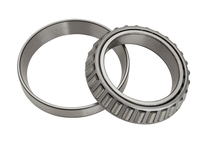
Image for Illustration purposes only. Actual product may vary
The NTN 864/854 is an inch series tapered roller bearing with a straight bore and open enclosure. Constructed from case carburized steel, this single row bearing is designed for applications requiring high radial and axial load capacity. Common uses include gearboxes, vehicle wheel hubs, and industrial machinery.
MODEL 864/854
$532.99 Each
Prices are subject to change
FREE SHIPPING ON ORDERS OVER $100
Select Quantity
Typically Ships in: 1 day
Returnable:No
a (Effective Load Center)
-0.6000 in
B (in)
3.7500
Bore Type
Round
Bore type
Round
Cone Number
864
Configuration
One
Cup Number
854
D (in)
7.5000
Dynamic Load Rating
94500 lbf
Dynamic load rating
94500 lbf
e (Axial Load Factor)
0.33
Enclosure
Open
I.D.
3.75 in
Lubrication
w/o Oil Hole
Material
Case carburized steel
O.D.
7.5 in
Operating Temperature Range
-40 to 250 °F
Operating temperature range
-40 to 250 ºF
Precision Rating
Class 2
Precision rating
Class 2
R (in)
0.31
r (in)
0.1300
Static Load Rating
144000 lbf
Static load rating
144000 lbf
Style
Cone & cup
Type
Tapered Roller Bearing
U
4.84 in
V
4.25 in
W
2.2500 in
Wi
2.2650 in
Width
2.265
Wo
1.7500 in
X
6.85 in
Y2 (Axial Load Factor)
1.79
Z
6.69 in
Technical Specifications
Type | Tapered Roller Bearing |
Bore Type | Round |
Material | Case Carburized Steel |
Style | Cone & Cup |
Precision Rating | Class 2 |
Cone Number | 864 |
Cup Number | 854 |
Configuration | One |
Lubrication | w/o Oil Hole |
e (Axial Load Factor) | 0.33 |
Y2 (Axial Load Factor) | 1.79 |
Static Load Rating | 144000 lbf640000 N640.00 kN |
Dynamic Load Rating | 94500 lbf420000 N420.00 kN |
Enclosure | Open |
Operating Temperature Range | -40 to 250 F-40 to 120 C |
Dimensional Specifications
| |
B | 3.7500 in95.250 mm |
D | 7.5000 in190.500 mm |
Wo | 1.7500 in44.450 mm |
Wi | 2.2650 in57.531 mm |
W | 2.2500 in57.150 mm |
r | 0.1300 in3.300 mm |
R | 0.31 in8.0 mm |
a (Effective Load Center) | -0.6000 in-15.200 mm |
U | 4.84 in123.0 mm |
V | 4.25 in108.0 mm |
X | 6.85 in174.0 mm |
Z | 6.69 in170.0 mm |


How do I choose the right type of bearing for my application?
Start with the load and how it’s applied. You need to know if you’re dealing with radial loads, axial loads, or a mix of both. Then look at speed, operating environment, and space constraints. For example, ball bearings are great for high speed and lighter loads, while roller bearings handle heavier loads but usually at lower speeds. If there’s contamination, moisture, or heat involved, you may need sealed bearings or specific materials. In most cases, the right choice comes down to matching load type, speed, and environment to the bearing design.