









We never sell your data to third parties
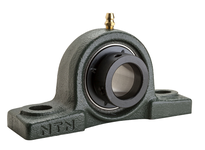
Image for Illustration purposes only. Actual product may vary
NTN UELP212-207D1 2-bolt cast-iron pillow block with eccentric collar locking. Bore 2-7/16 in (61.9 mm). Pre-lubricated ball bearing insert for conveyor, fan, and light industrial applications.
MODEL UELP212-207D1
$169.35 Each
Prices are subject to change
FREE SHIPPING ON ORDERS OVER $100
Select Quantity
Typically Ships in: 1 day
Returnable:No
A (in)
2.7500
B1
3.0630 in
Bearing Number
UEL212-207D1
Bearing number
UEL212-207D1
Bearing Type
Ball Bearing
d (in)
2.4375
Dynamic Load Rating
11800 lbf
Dynamic load rating
11800 lbf
End Type
Open
End type
Open
F (in)
0.2441
H (in)
2.7500
H1
0.9687 in
H2
5.4375 in
Housing Construction
1 Piece
Housing construction
1 Piece
Housing Material
Cast Iron
Housing material
Cast iron
Housing Number
P212D1
I.D.
2.4375 in
J (in)
7.2500
L (in)
9.5000
L1
2.7500 in
Locking Device
Eccentric Locking Collar
Locking device
Eccentric locking collar
Lubrication
Relubricatable
Max Rotational Speed
2500 RPM
N (in)
0.7812
N1
0.9062 in
O.D.
4.3307 in
Operating Temperature Range
-40 to 250 °F
Operating temperature range
-40 to 250 ºF
Performance
Light Duty
S
1.2205 in
Seal Material
Nitrile Rubber
Seal material
Nitrile rubber
Seal Type
Contact
Seal type
Contact
Static Load Rating
8100 lbf
Static load rating
8100 lbf
Type
Pillow Block Unit
Width
3.063 in
Technical Specifications
Type | Pillow Block Unit |
Bearing Type | Ball Bearing |
Locking Device | Eccentric Locking Collar |
Seal Type | Contact |
Seal Material | Nitrile Rubber |
Bearing Number | UEL212-207D1 |
Housing Number | P212D1 |
Housing Material | Cast Iron |
Housing Construction | 1 Piece |
End Type | Open |
Performance | Light Duty |
Dynamic Load Rating | 11800 lbf52500 N52.50 kN |
Static Load Rating | 8100 lbf36000 N36.00 kN |
Rotational Speed [Max] | 2500 RPM |
Weight | 10.979 lb4.980 kg |
Operating Temperature Range | -40 to 250 F-40 to 120 C |
Dimensional Specifications
| |
d | 2.4375 in61.913 mm |
J | 7.2500 in184.0 mm |
L | 9.5000 in241.0 mm |
A | 2.7500 in70.0 mm |
H | 2.7500 in69.8 mm |
H1 | 0.9687 in25.0 mm |
H2 | 5.4375 in138.0 mm |
L1 | 2.7500 in70.0 mm |
N | 0.7812 in20.0 mm |
N1 | 0.9062 in23.0 mm |
B1 | 3.0630 in77.800 mm |
S | 1.2205 in31.000 mm |
F | 0.2441 in6.200 mm |

How do I choose the right type of bearing for my application?
Start with the load and how it’s applied. You need to know if you’re dealing with radial loads, axial loads, or a mix of both. Then look at speed, operating environment, and space constraints. For example, ball bearings are great for high speed and lighter loads, while roller bearings handle heavier loads but usually at lower speeds. If there’s contamination, moisture, or heat involved, you may need sealed bearings or specific materials. In most cases, the right choice comes down to matching load type, speed, and environment to the bearing design.