







We never sell your data to third parties
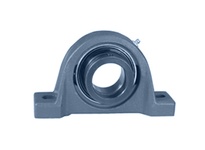
Image for Illustration purposes only. Actual product may vary
Link-Belt P3W224E 10406456 is a 2-bolt pillow block ball bearing with a 1" bore and eccentric locking collar. The cast iron housing is powder coated for corrosion resistance. It features a Buna single lip contact seal and a nylon retainer. This fixed (non-expansion) unit is rated for intermediate duty with a dynamic load rating of 7330 lbf and a static load rating of 4460 lbf.
MODEL 10406456
Contact supplier for technical support on: 800-626-2120
$106.05 Each
Prices are subject to change
FREE SHIPPING ON ORDERS OVER $100
Select Quantity
Typically Ships in: 1 day
Returnable: Yes
Ability to Relubricate
Yes
Adjustment slot width (in)
Active in
Adjustment Slot Width (mm)
True mm
Available end cap
Y2256N
Base Length (in)
7.06
Base to centerline height (in)
2
Base Width (in)
1.88
Bearing Insert Material
52100 Bearing Steel
Bolt hole spacing (width) (in)
5.48
Bore Shape
Straight
Bore size (in)
1.5 in
Cage Material
Molded fiber glass reinforced nylon
Cage Type
Ball Riding Retainer
Distance between bolt holes (in)
5 3/8
Distance from Bearing Centerline to Cap Face (in)
1 47/64
Distance from Bearing Centerline to Outer Most Bearing Face (in)
1 9/32 in
Duty/Series
Intermediate duty
Fixed vs. Expansion
Fixed
Foot Height (in)
0.81
Grease Fitting Thread Size
1/8 NPT
Height
2.44
Housing Base
Semi-Solid
Housing coating
Powder coated
Housing Color
Black
Housing construction
One Piece
Housing height (in)
4 in
Housing material
Cast iron
Housing style
Pillow block
Housing type
Pillow Block, Two Bolt
Inner Ring Outside Diameter (in)
2.084
Insert
WG224EL
Length
7.94
Length Through Bore (in)
1.72
Locking collar outside diameter (in)
2 3/8 in
Locking device kit
W2245S
Locking Type
Eccentric
Lubricant
Lithium Complex NLGI 2 Grease
Lubrication type
EXXON RONEX MP STD
Max distance between bolt holes (in)
E lip seal
Max distance between bolt holes (mm)
2
Maximum Speed (RPM)
4500 rpm
Maximum Temperature (C)
107 C
Maximum Temperature (F)
225 F
Misalignment Capability
±2.0° Misalignment - Static Only
Misalignment Type
Static Only
Mounted clearance
C3 standard
Mounting bolt hole slot length (in)
15/16 in
Mounting bolt size (in)
1/2 in
Mounting pad height (in)
13/16 in
Mounting pad length (in)
7 1/16 in
Mounting pad width (in)
1 7/8 in
Outer Ring Land Profile
Standard
Primary seal
BUNA single lip contact seal
Radial Dynamic Load Capacity (lb)
7330 lb
Radial Static Load Capacity (lb)
4460 lb
Retainer type
Nylon
Rolling element
Ball Bearing
Seal type
Single lip contact seal
Setscrew torque (in-lbs)
290-325 in/lbs
Size code
208
Unit of dimension
in
Vibration frequency fundamental train
0.0065 cps
Vibration frequency inner ring defect
0.0912 cps
Vibration frequency outer ring defect
0.0588 cps
Vibration frequency roller spin
0.0367 cps
Volume
0.393
Volume unit
GLL
Width
4.69
1 1/2" Mounted Ball Bearing, Intermediate Duty, Cast Iron 2-Bolt Pillow Block, Eccentric Cam Locking Collar, Single Lip Contact Seal
How do I choose the right type of bearing for my application?
Start with the load and how it’s applied. You need to know if you’re dealing with radial loads, axial loads, or a mix of both. Then look at speed, operating environment, and space constraints. For example, ball bearings are great for high speed and lighter loads, while roller bearings handle heavier loads but usually at lower speeds. If there’s contamination, moisture, or heat involved, you may need sealed bearings or specific materials. In most cases, the right choice comes down to matching load type, speed, and environment to the bearing design.


